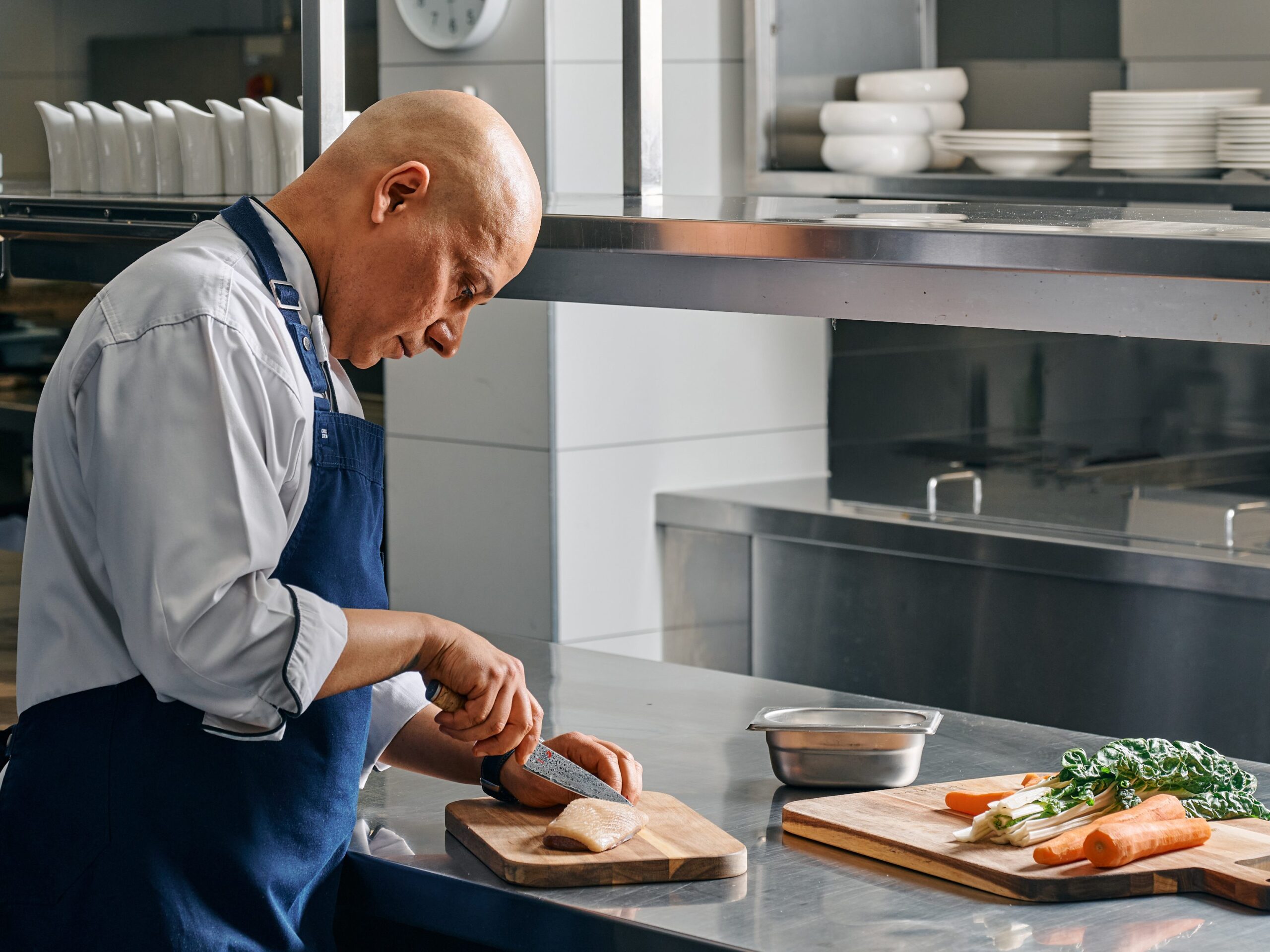
“I often say, the one major attribute that differentiates good chefs from great ones is consistency,” Pawan Dutta, executive chef at The Royce Melbourne, tells Hospitality. This consistency, stresses Dutta, comes down to having the right tools. “These tools empower me to focus on what really matters: The finesse, the flavour, and the creativity.”
Dutta is no stranger to delivering high quality food on a world-class stage. He’s worked in exclusive hotels across India, Dubai, Qatar, and Japan, and his job has taken him to every continent on the globe. Now, the chef calls Australia home, and the Victorian Accommodation Awards recently named him Victorian Chef of the Year 2025, recognising his contribution to the local culinary landscape.
Dutta says the win brought him a mixture of pride, validation, and deep gratitude. “As time goes by, I’m seeing the ripple effect of how important [the win] was,” he says. “It’s not just about the title. It’s everything that it represents: the hard work, the creativity, the discipline. All these years are paying off. It’s not just about me, but it’s also about my sous-chefs, my chef de parties, my pastry chef, breakfast chef, and even my kitchen hands.”
Dutta has worked in luxury environments including Madinat Jumeirah in Dubai, Sharq Village and Spa in Qatar, mega luxury residential yacht The World, and Conrad in Maldives and Tokyo. It was during his time in Japan that the chef first began using Miyabi knives. The tools are meticulously handcrafted in Seki, Japan’s “city of knives”, which has a tradition of blade-making reaching back to the 13th century.
“The knife is an extension of a chef’s hands, so when you hold it, how you feel is very important,” says Dutta. “There are certain attributes you look for, and Miyabi hits all of them.”
Every Miyabi Knife is hand crafted and finished with 130 intricate production steps over 42 days. The company’s premium Birchwood 5000MCD Series is constructed with micro-carbide powder steel cores and each knife is embedded in 100-layers of steel, creating their intricate Damascus pattern. Their handles are made from rare masur birch which provides both an aesthetic and tactile benefit. The result is a beautiful series of knives which are both tough and resilient, and sharp enough to cut with surgical precision. The 5000FCD Series features a fine carbide steel blade core, which is embedded in 48 layers of steel, again creating the iconic Damascus design. The black pakka wood handle has a steel cap end with decorative pin and ring. Both series of blades are ice hardened to ensure extreme hardness, corrosion-resistance, and material elasticity.
Miyabi Development Manager Masayuki Yamada says that rather than being a factory product, making the knives is “closer to a work of art. Something that evokes emotion.”
Tools of the trade
For Dutta, much of his consistency he credits to his toolkit. Apart from his knives, he recognises the impact of a good digital thermometer, which takes the guesswork out of cooking proteins and during baking; the sous vide immersion circulator; and the Microplane, “which helps balance and layer flavours”.
He also notes that a sharpening stone is crucial to ensure his knives remain honed. “A dull knife is more dangerous than a sharp one,” says Dutta. “Chefs using dull knives have to exert more force and more pressure, meaning they’re more likely to slip. We all know Miyabi’s knives are so, so sharp.”
Japanese knives tend to be thinner than their German counterparts, allowing for a sharper edge. They’re also reasonably light, which Dutta notes is a benefit during long hours on his feet.
Newcomers are always finding their way into his toolkit; he only recently became fond of using plating tweezers – something he picked up since moving to Australia. “I used to give other chefs a hard time and say, ‘we have fingers, why can’t we use them to pick up the flower and put it on the plate?’,” says Dutta. But after watching his sous chef, his breakfast chef, and his pastry chef religiously using them, he decided to try them out. “It actually really increases the accuracy. So I’m on the same page as them now,” laughs the chef.
This attitude of humble, continuous learning is one the chef has taken with him throughout his career, and something he wishes to impart on up and comers in the industry.
“For young chefs, I will say to keep your head down and learn your craft,” says Dutta. “The chef’s job is one which doesn’t have instant gratification. It builds over time, and you’ll see the results much later in life. So, learn as much as possible, work with different chefs, try different techniques, travel, meet new people, and learn about their cultures. Don’t run after success; there will be a time when success will run after you.”
The chef believes that everything in the kitchen requires proper attention and care, and knives are no exception. “Take care of your knives, and they’ll take care of you,” says Dutta.
Photography by Pete Dillon.
This article was created in partnership with Miyabi and was originally published in the November / December edition of Hospitality magazine. Explore the magazine or subscribe here.
Leave a Reply