In Japan, konibi, or convenience stores, are an integral part of daily life. The tiny 24/7 shops go above and beyond their Australian counterparts, with hot food and pre-made meals like onigiri, bento boxes, and noodles, alongside household items, alcohol, and services like bill payment and parcel collection.
Looking to bring a taste of this culture to Melbourne, Stefanie Breschi, Alex Boffa, and Head Chef Atsushi Kawakami – the team behind Richmond’s Future Future – set up Suupaa in Cremorne’s 65 Dover Street development, which is also home to the latest rendition of cult bread and pastry afficionados Baker Bleu.
Working with If Architects, the team set about developing a venue that acted as a fast-casual hybrid between a Japanese restaurant and a konbini-style convenience store in a bid to “establish a new hospitality model”, according to If Architects’ Iva Foschia.
“The client identified the target customer as cultured, well-travelled, and tech-savvy, and the interiors integrate innovation, and global sensibilities to engage this audience,” says Foschia.
“[The space merges] hospitality and retail into one cohesive, design-led environment that feels both efficient and elevated.”
Designing for fast casual
Looking to reference Japan’s ‘konbini’ in the design, the architects embedded subtle nods to Japanese culture, the first of which appears in the venue’s name, which is the Japanese word for both “super” and “supermarket”.
“The design reinterprets the konbini archetype rather than replicating it, translating utility, precision, and constant motion into a contemporary Melbourne context,” says Foschia.
“Clean lines, modular displays, and strict organisation evoke Japanese convenience culture, while fluorescent lighting and evocative graphic projections infuse the space with a modern, dynamic energy.”
Delineating space
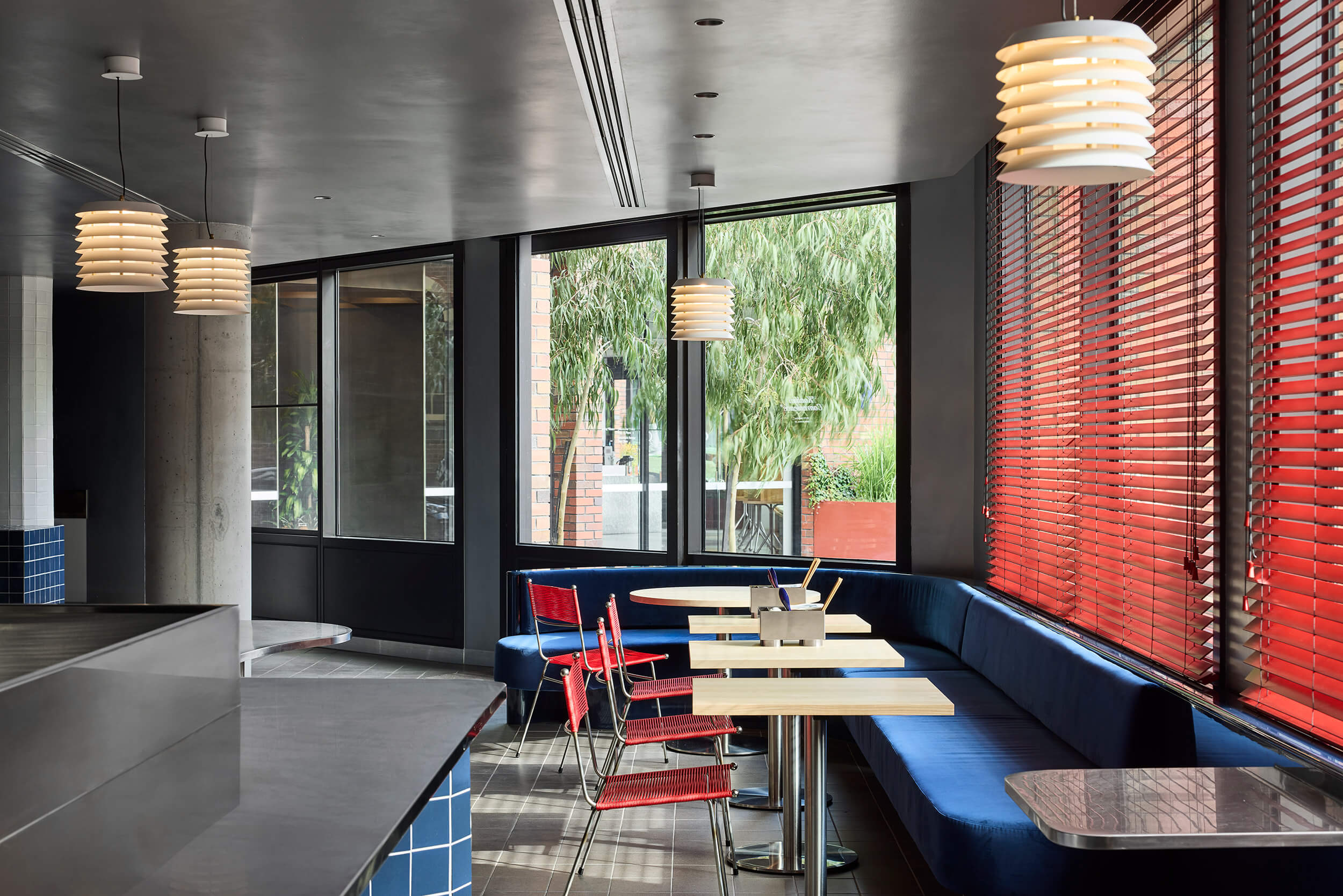
In order to delineate each section of the dual use space, the designers used the ‘goshiki’ colour system to guide special hierarchy, with whites for retail and blues for dining.
“While the konbini zone is crisp and highly efficient, the dining area softens the experience through warm light, timber surfaces, soft upholstery, and flowing curves that encourage lingering, tactile environment,” says Foschia.
Materials like stainless steel and tiles embody utilitarian honesty of konbini and durable, open-kitchen environments.
“The layout positions the konbini at the front and dining to the back, creating a natural flow that moves customers through the shop while supporting fast circulation. At the same time, the design balances speed with hospitality, making the space welcoming and comfortable for dine-in guests.”
Foschia says the project thrived on collaboration thanks to a client rich in research and expertise in both food and retail, and contributions from graphic consultant A Friend of Mine.
For exclusive hospitality news every Tuesday and Thursday, subscribe here or follow us on LinkedIn and Instagram.
Leave a Reply